Marthas Display Font for Handmade Creators
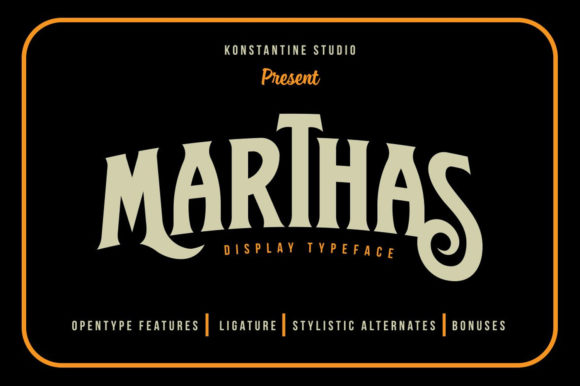
If you’ve ever spent hours tweaking a label design only to realize the typeface feels too safe—or worse, forgettable—you’ll understand why Marthas has become my go-to display font for physical and digital product work. It’s not just another bold typeface. Marthas is cool, intentionally rough-textured, and unapologetically vintage-styled—designed to command attention without shouting. As a maker who prints candle labels, cuts vinyl stickers, designs wedding welcome boards, and sells printable planner pages on Etsy, I need fonts that hold up in real-world production—and still feel personal, intentional, and full of character.
What makes Marthas especially useful is its tactile visual rhythm. The slight irregularity in stroke weight and texture gives it authenticity—it looks hand-painted or screen-printed, not digitally polished. That’s gold when you’re building brand consistency across product tags, packaging, and social media graphics. Customers don’t just read your “Small Batch Lavender Soy Candle” label—they *feel* its craftsmanship, partly because Marthas adds that subtle, grounded warmth. It works beautifully at medium to large sizes: think 24pt+ on a kraft paper tag, 48pt+ on a farmhouse-style wall sign, or even 72pt+ as a focal point on a printable wedding invitation suite.
But here’s what matters most in practice: readability meets personality. Marthas isn’t built for paragraphs—but it shines where impact matters most. Use it for shop names on tote bags, seasonal greetings on holiday mugs, boutique gift card holders, or SVG-cut wooden signs for craft fairs. I’ve used it for “Welcome Home” on a painted plywood sign (cut with my Cricut Maker), and the texture translated perfectly into the engraved grain. For sticker sheets? It holds up crisply down to 14pt on glossy vinyl—just avoid tight kerning below 10pt if you’re laser-cutting fine details. And yes—it previews cleanly in mockups, whether you’re showing clients a printable wall art PDF or prepping a Canva template for digital download buyers.
Real-world pairings matter just as much as the font itself. Marthas plays exceptionally well with contrast. Try pairing it with a clean sans serif like Montserrat or Poppins for body text on greeting cards or product descriptions—this combo keeps things legible while letting Marthas own the emotional hook. For wedding stationery, I often layer it over a delicate script font (like Allura or Great Vibes) for names or monograms, then drop in a simple serif like Lora for RSVP details. The result? A hierarchy that guides the eye and feels cohesive—not chaotic. No swashes or ligatures are listed with Marthas, which actually works in our favor: fewer variables mean faster file prep, cleaner cut files for Silhouette Studio, and smoother export from Adobe Illustrator or Affinity Designer.
Because Marthas is a display font—not a serif or sans serif workhorse—it thrives in short bursts: shop logos, title pages, header banners, mug quotes, jar labels, and banner flags. I use it for “Hand-Poured” on soy wax candle jars, “Farmhouse Fresh” on produce boxes at local markets, and “Est. 2023” on my small-batch soap labels. Its boldness ensures visibility on textured surfaces like burlap, kraft paper, or matte ceramic—no fading into the background. And unlike some overly distressed fonts, Marthas retains clarity at smaller display sizes, making it reliable for 2” x 3” product tags or 1.5” round stickers.
File format support is straightforward: Marthas comes in standard OTF and TTF formats—fully compatible with Cricut Design Space, Silhouette Studio, Adobe Creative Cloud, Canva Pro, and Microsoft Word. No webfont or variable weight options are included, but that’s fine for craft-based workflows where consistency and simplicity win. There’s no multilingual expansion beyond basic Latin characters (A–Z, numerals, common punctuation), so it’s ideal for English-language product labeling, US/EU-focused printables, and domestic Etsy shops—but keep that in mind if you plan global expansion.
Licensing is where many makers get tripped up—so let’s be clear: Marthas is a commercial font, meaning you’re fully covered to use it in physical products you sell (stickers, mugs, apparel, signage), digital downloads (PDF planners, Canva templates, SVG cut files), client design work, and even social media graphics for your shop. You do not need an extended license to sell items featuring Marthas—as long as you’re not reselling the font file itself or embedding it in editable software tools. Always double-check the license terms before bundling it into a template pack for resale, but for 99% of handmade sellers and printable creators? You’re good to go.
I’ve tested Marthas across seasons and product types—and it adapts beautifully. In spring, it softens into “Garden Gatherings” on seed packet labels. In fall, it grounds “Pumpkin Spice & Everything Nice” on bakery tags. At Christmas, it wraps warmly around “Made With Love” on handmade ornament packaging. Even in minimalist branding, Marthas adds quiet confidence—think black ink on ivory linen for boutique tea labels, or white foil stamping on navy cardstock for luxury invitation suites. Its charm isn’t loud; it’s earned through texture, intention, and thoughtful placement.
When you choose Marthas, you’re choosing more than a font—you’re choosing a consistent tone for your handmade business. It tells customers your work is considered, tactile, and rooted in real craft—not mass-produced trends. Whether you're designing a single SVG file for Etsy or building a full product line with coordinated packaging and digital assets, Marthas helps unify your visual language without sacrificing individuality. It doesn’t try to be everything. It does one thing brilliantly: make your creations stand out—authentically.